

In the digital era, the demand for live sports streaming continues to grow exponentially, but the high cost of official subscription services has pushed some users toward unofficial, free alternatives. MethStreams and CrackStreams have emerged as two of the most widely discussed platforms in this controversial space. While they promise access to premium sports content without the hefty price tag, navigating these sites often entails high hidden costs. Users frequently encounter unreliable performance, aggressive advertising, and significant cybersecurity threats. This article will objectively compare the positioning, content offerings, user experience, and inherent security risks of both MethStreams and CrackStreams. By examining the realities of these unauthorized streaming aggregators, we aim to help readers make safer, more informed judgments about their digital viewing habits.
What Is MethStreams?
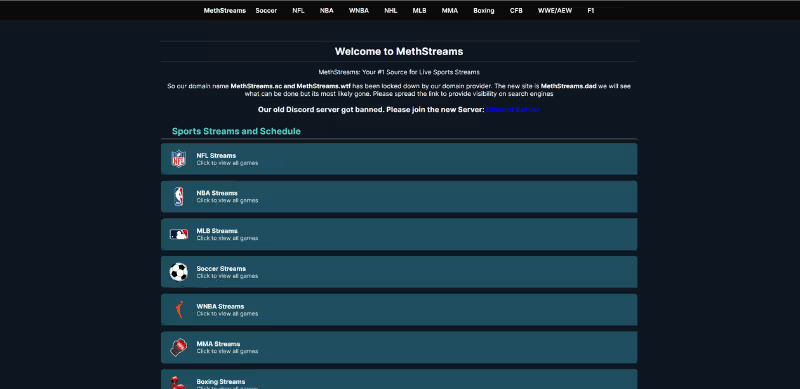
MethStreams Platform Positioning
MethStreams is widely recognized in the unofficial streaming community as a branch, mirror, or modern alternative to the traditional CrackStreams brand. It operates purely as an aggregator, functioning by compiling and categorizing third-party links for various live sports events rather than broadcasting or hosting the content on its own servers. This distinction means the platform acts merely as a directory that points users to external media players scattered across the web.
The platform has built its reputation by covering a wide array of popular event categories, with a particular emphasis on high-profile American sports leagues such as the NFL and NBA, as well as major combat sports like UFC and boxing. Because it operates on an aggregation model, its content availability is highly dependent on the uptime of those external, unauthorized hosts, making the viewing experience inherently unpredictable.
User Experience and Platform Features
Navigation and interface design: MethStreams distinguishes itself by offering a more modern website interface than older streaming directories. The layout is typically designed with a dark mode aesthetic, making it visually appealing and somewhat easier to navigate when searching for specific upcoming matches or live events.
Link update speed: The site typically updates its broadcast links shortly before a major event begins, often within the hour before kickoff or the main card. While they attempt to provide multiple backup sources for high-traffic games, the reliability of these redundant links fluctuates dramatically as copyright holders issue takedowns.
Ad intrusiveness: MethStreams’ monetization model relies heavily on aggressive, intrusive advertising. When users click a link or interact with the video player, they often encounter a barrage of pop-ups, invisible overlays, and forced redirects. These aggressive ad placements are not just annoying; they pose substantial malware risks, as many redirects lead to unvetted or actively malicious third-party websites designed to compromise visitors’ devices or harvest personal data.
Pros and Cons of MethStreams
While MethStreams holds a prominent place in the unofficial sports streaming space, it carries significant drawbacks that users must weigh carefully against its perceived benefits.
| Strengths | Shortcomings |
|---|---|
| Free access to premium sports | Overwhelming, aggressive pop-up advertisements |
| No user registration required | High risk of malware and device infection |
| Broad coverage of popular events | Severe copyright and legal risks for users |
| Modern, dark-themed interface | Frequent dead links and buffering issues |
| Multiple backup links are usually listed | Serious data privacy exposure concerns |
Main Target Audience and Common Viewing Interests
MethStreams primarily attracts a specific demographic of sports fans who are unwilling or unable to pay the increasingly high fees associated with official pay-per-view (PPV) events and premium cable subscriptions. Its audience largely consists of users actively searching for specific, high-stakes combat sports events or out-of-market football and basketball games that are otherwise locked behind regional blackouts or expensive network paywalls.
What Is CrackStreams?
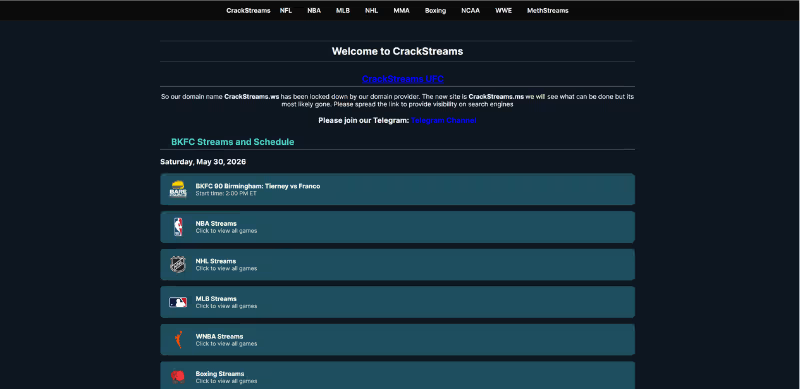
CrackStreams is an older, historically prominent, and widely recognized brand within the unofficial streaming ecosystem. For many years, the name has served as synonymous with free sports broadcasts, drawing millions of viewers worldwide who seek unauthorized access to live games. Despite its massive brand recognition, the original entity has long been fragmented, resulting in a complex web of copycat sites that leverage its famous name to attract organic search traffic.
Platform Features and Streaming Quality
- Brand recognition and mirror sites. Because the original CrackStreams platform has frequently been targeted by authorities, blocked by Internet Service Providers, and taken down via domain seizures, the current landscape is flooded with mirror sites. These numerous clones use variations of the CrackStreams name, making it nearly impossible for users to determine which site is relatively “functional” and which is a dangerous phishing trap.
- Streaming resolution and delay. The visual quality across these varied mirror sites usually hovers around 720p, occasionally reaching 1080p, though compression artifacts are common. Furthermore, users regularly experience noticeable delays compared to official live television broadcasts, so viewers often see scoring updates on social media several minutes before the play appears on their screens.
- Device compatibility. The streaming performance across different devices is highly inconsistent. While it can technically be accessed via PC and mobile web browsers, the responsive design on smartphones is often broken by overlapping advertisements. Attempting to cast these unauthorized video players to a smart TV frequently results in formatting errors, endless buffering, or immediate player crashes.
Pros and Cons of CrackStreams
CrackStreams remains a widely used name, but using its modern mirror sites means navigating a minefield of digital hazards.
| Strengths | Shortcomings |
|---|---|
| Extremely high brand recognition | Hard-to-verify mirrors and high phishing risk |
| Covers almost all mainstream sports | Highly unstable domains that frequently vanish |
| Long history of providing PPV access | Substantial legal concerns and ISP blocking |
| No subscription fees required | Poor mobile viewing experience and video delay |
| Simple, list-based event directory | Constant exposure to malicious ad networks |
Core Sports Categories Covered
The CrackStreams brand is most famous for its comprehensive coverage of major live sporting events. Historically, its most popular broadcast categories have included high-profile Boxing matches, MMA pay-per-views, and regular-season games for the NFL and NBA. It essentially targets the most lucrative, high-demand sports content available.
Comparative Overview of MethStreams and CrackStreams
This chart summarizes the core differences and underlying similarities between MethStreams and CrackStreams across several key attributes, highlighting the profound risks and inconsistent user experiences inherent to both unauthorized platforms.
| Feature | MethStreams | CrackStreams (Mirrors) |
|---|---|---|
| Interface Friendliness | Modern, dark-themed UI | Often cluttered, varied by a mirror |
| Ad Volume | Extremely high, redirect-heavy | Extremely high, deceptive overlays |
| Link Stability | Fluctuates, links die mid-game | Highly unstable, frequent buffering |
| Featured Sports | NFL, NBA, UFC, Boxing | MMA, Boxing, NFL, global sports |
| Privacy Risk | Severe tracking and malware risk | Severe phishing and malware risk |
| Legality | Unauthorized, high legal risk | Unauthorized, high legal risk |
Main Differences and Shared Characteristics Between the Two
1. Content Variety and Update Frequency
When comparing the content priorities of the two platforms, subtle differences emerge in how they aggregate event links. MethStreams often positions itself to update newer, high-profile PPV events—such as major UFC or boxing title fights—somewhat more quickly, attempting to cater to a highly engaged combat sports audience. They tend to prioritize the biggest events of the night to capture peak traffic. CrackStreams, on the other hand, due to its decentralized nature and the sheer volume of varied mirror sites, often presents a much more cluttered directory but arguably boasts broader overall coverage. A user might find niche sports or lesser-known international soccer matches on a CrackStreams clone that MethStreams simply does not bother to index. However, this broad coverage comes at the cost of curation, as many links listed on CrackStreams mirrors are dead long before the user even attempts to click them.
2. Advertising Model and Pop-Up Intrusiveness
The “free” nature of both platforms is an illusion; users essentially pay with their digital safety and attention. Both platforms rely heavily on incredibly aggressive advertising models to generate illicit revenue. These tactics include deploying fake “play” buttons, invisible overlays that trigger upon the first click, and relentless redirects to gambling promotions or adult websites. When comparing the two, MethStreams often utilizes slightly more modernized, embedded ad networks that force users through multiple layers of pop-ups before revealing the actual video player. CrackStreams mirrors, being less centralized, can be wildly unpredictable; some may have easily dismissible banner ads, while others trap the user in inescapable redirect loops. Ultimately, both platforms feature highly intrusive ad behaviors that severely degrade the viewing experience.
3. Security, Privacy, and Malware Risks
The most critical shared characteristic between MethStreams and CrackStreams is the massive cybersecurity threat they pose to their audiences. Neither of these platforms is regulated, audited, or bound by standard consumer protection laws. Consequently, browsing either site exposes users to severe risks, including drive-by downloads, trojans, browser hijackers, and invasive data trackers. Clicking on the wrong deceptive pop-up can easily result in a device becoming infected with malware or ransomware. Furthermore, these sites often harvest IP addresses and digital fingerprints without consent. In this crucial area, MethStreams and CrackStreams are highly consistent: they both operate in a completely insecure ecosystem where the viewer’s privacy and device integrity are actively jeopardized for profit.
4. Interface Design and Usability
From a usability standpoint, the two brands offer noticeably different visual experiences. MethStreams usually presents a darker, more focused, and relatively modern user interface that attempts to mimic the look and feel of legitimate digital media platforms. This design choice can make finding specific games slightly more intuitive. In stark contrast, the interface design of CrackStreams mirror sites varies wildly from domain to domain. Some mirrors stubbornly retain the classic, simplistic list-based layout of the original site from years past, while others are chaotic, cluttered messes filled with broken images and misaligned text. Because anyone can launch a site with the CrackStreams name, there is zero consistency in usability, making it a frustrating gamble for the end user.
5. Domain Stability and Legal Issues
Both MethStreams and CrackStreams operate firmly within a legal black area, functioning as unauthorized third-party aggregators of copyrighted broadcast material. Because they facilitate mass copyright infringement, they are in a constant cat-and-mouse game with major sports leagues, anti-piracy coalitions, and Internet Service Providers. They face relentless DMCA takedown notices and domain seizures. As a direct result, the URLs for both platforms change with alarming frequency. This severe domain instability not only makes it difficult for users to reliably find streams but also drastically increases the likelihood that users will accidentally navigate to a malicious phishing site masquerading as the real platform. The legal and operational instability makes both platforms inherently unreliable.
Conclusion and Legal, Safer Alternatives
To sum up, while MethStreams and CrackStreams may initially appear to offer an attractive, free solution for accessing premium sports events, the actual cost to the user is alarmingly high. Viewers on these platforms are forced to endure poor broadcast stability, excessive and deceptive advertising, and severe, undeniable legal and cybersecurity risks. At their core, these two entities are virtually identical in their risk profiles; both function as unauthorized third-party link aggregators that operate completely outside the bounds of digital safety regulations. The minor differences in their user interfaces or specific sports coverage do not mitigate the overarching threat of malware infection or data compromise.
For the sake of personal cybersecurity and a vastly superior viewing experience, sports fans are strongly encouraged to choose safe, official, and legal alternative streaming services. Licensed platforms such as ESPN+, FuboTV, Peacock, and DAZN offer unmatched value that unauthorized sites simply cannot replicate. While these official services do require a paid subscription, they guarantee high-definition video quality, completely malware-free environments, reliable app ecosystems, multi-language commentary, and on-demand replay support. Choosing authorized broadcasters not only supports the sports industry but also ensures that your digital privacy and hardware remain entirely secure.
FAQ
Is MethStreams safer to use than CrackStreams?
Not significantly. While the two sites may differ in layout, link organization, or event focus, both operate as unofficial sports streaming aggregators and carry many of the same risks. Users may encounter intrusive ads, broken links, phishing attempts, and potential exposure to malware on either platform. From a cybersecurity and privacy standpoint, neither should be considered truly safe.
Why do these streaming websites change their URLs so often?
These websites often change domains because they face frequent takedowns, ISP blocks, and copyright enforcement actions. When one domain becomes unavailable, mirror sites or replacement URLs may appear under a similar name. This constant turnover is one reason users often struggle to identify legitimate pages and may accidentally land on misleading or malicious copies.
Can these sites cause malware infections on my computer?
Yes, they can. Many unofficial streaming websites rely on aggressive ad networks, pop-ups, redirects, and deceptive buttons that may expose users to harmful content. In some cases, visiting or clicking through these pages can lead to browser hijacking, suspicious downloads, tracking scripts, or malware infections. This is one of the biggest risks associated with unauthorized streaming platforms.
Are there free legal ways to watch live sports online?
In some cases, yes. Free legal access may be available through official promotional trials, broadcaster highlights, league apps, local over-the-air channels, or selected live events offered by licensed platforms. Availability depends on the sport, region, and broadcasting rights, but these options are generally much safer and more reliable than unofficial streaming websites.
Why does the video buffer during major sporting events?
Buffering is common during major events because unofficial streaming links often rely on overloaded third-party servers with limited capacity. When too many users try to watch the same match at once, stream quality may drop, or playback may freeze. Heavy ad scripts, unstable hosting, and frequent redirects can also worsen the viewing experience.